Summary:
Short on time? Here’s what you need to know:
- Google’s May 2026 core update rolled out between May 21 and June 2, 2026
- The focus stayed the same—trust, expertise, and usefulness—but Google got sharper at measuring it
- Senior living is one of Google’s most scrutinized categories, so the impact lands more directly here
- AI Overviews now answer common senior-care questions upfront, and pages that used to win that traffic are losing clicks
- Pages that gained ground share one trait: built for users first, not search engines
Google’s May 2026 core update rolled out, and everyone’s trying to figure out what happened. Reddit threads are asking whether the volatility hit their business; YouTube is loaded with videos promising explanations and fixes.
For senior living organizations, this noise can be overwhelming, and a more important question gets lost: What does this update reveal about how Google evaluates senior living websites today?
At Fountain Digital, we dug into the rollout, reviewed Google’s official documentation, and pulled together what we learned. This piece breaks down what changed, who felt it, and what it signals for senior living search going forward.
What Exactly is a Google Core Update?
A Google core update is a broad change to the way Google evaluates and ranks content across the web. Unlike smaller updates like spam updates that target a specific issue, core updates affect Google’s search systems more broadly and can influence rankings across industries and website types.
Google releases these updates several times a year to improve the quality and relevance of search results. The goal isn’t to penalize specific websites but to reassess what content is most helpful, reliable, and useful for searchers.
A drop in visibility after a Google core update can mean a few different things:
- A competitor’s content has improved and now ranks above yours
- Google’s evaluation criteria shifted in a direction your content doesn’t yet reflect
- Newer, more specific resources have entered the search landscape
- Your content hasn’t been refreshed recently enough to stay competitive
None of these is a permanent verdict, but all of them are worth understanding.
The May 2026 Google core update follows this same pattern. Rather than introducing entirely new rules, it offers a fresh look at what Google currently values when deciding which websites deserve visibility. That’s where things get particularly relevant for the senior living industry.
Inside Google Core Update May 2026: Changes & Themes
Google officially launched the May 2026 core update on May 21, 2026, at 08:43 PDT and completed the rollout on June 2, 2026 at 05:43 PDT.
Over those two weeks, websites across industries experienced significant ranking fluctuations as Google’s systems reassessed how content should be evaluated and surfaced in search results.
While Google didn’t publish a detailed list of ranking changes, several themes emerged from the rollout. Looking at Google’s guidance, industry analysis, and the visibility shifts observed across search results, a clearer picture begins to emerge.
1. E-E-A-T Continues to Matter
One of the clearest themes from the May 2026 core update is that Google continues to place a high value on trust and expertise.
In Google’s language, this falls under E-E-A-T, i.e., Experience, Expertise, Authoritativeness, and Trustworthiness. While the acronym may sound technical, the idea is straightforward: Google wants to surface information from sources that demonstrate real knowledge and credibility.
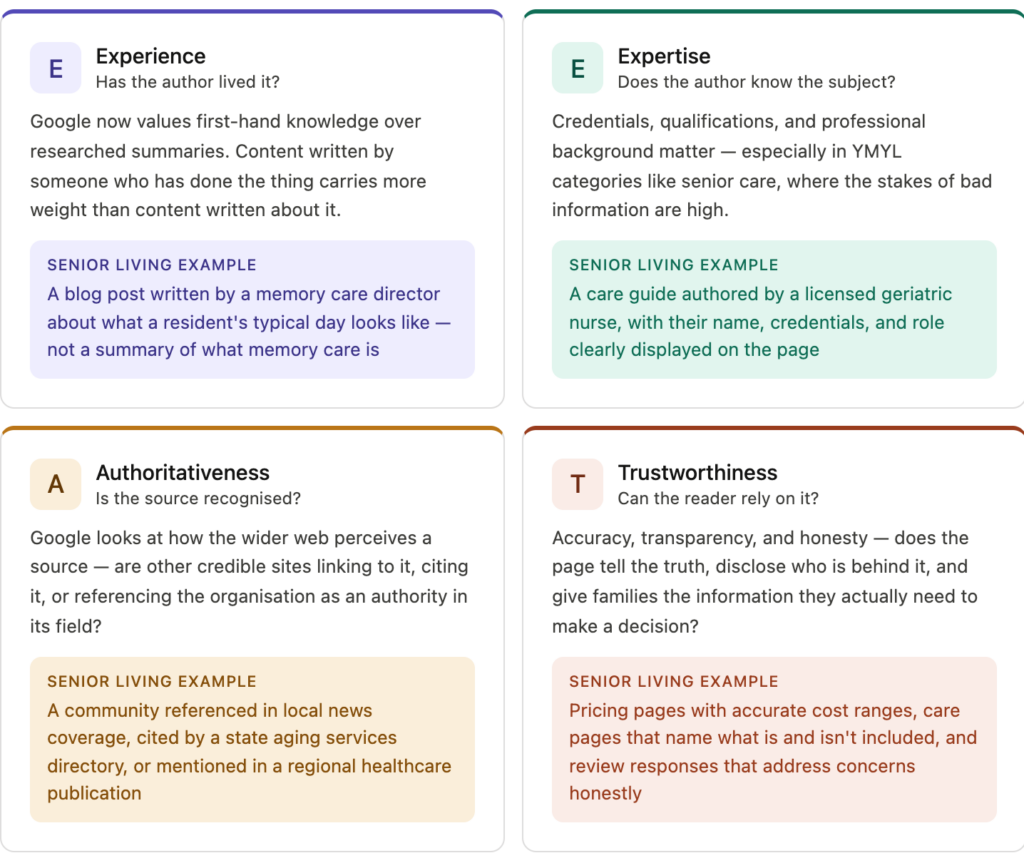
Think about the difference between the two articles on the same topic. One simply summarizes information already available online. The other includes first-hand experience, expert insights, original research, or practical examples. Increasingly, Google appears to be favoring the second type of content.
That’s why many SEO professionals observed a common pattern during the rollout: content backed by genuine expertise and real-world experience generally held up better than content created primarily to target SEO keywords.
The takeaway is simple. Publishing content on a topic is no longer enough. Google is getting better at identifying who is actually qualified to talk about that topic and whether they’re adding something useful to the conversation.
2. Original Content Is Becoming More Valuable
Expertise alone, however, isn’t enough.
The Google core update May 2026 also highlighted the growing importance of originality. With AI tools making it easier than ever to produce content at scale, Google faces a new challenge: distinguishing genuinely useful information from content that simply repeats what already exists online.
As a result, many analysts observed stronger performance among websites publishing original research, unique perspectives, proprietary data, case studies, and insights unavailable elsewhere.
In other words, Google appears to be rewarding content that contributes something new rather than content that simply summarizes what’s already ranking.
3. Search Intent Is Becoming More Important Than Keywords Alone
Another theme emerging from the update is Google’s increasing ability to understand search intent.
Historically, ranking success was often associated with targeting the right keywords. Today, Google’s systems are becoming more sophisticated at understanding what users are actually trying to accomplish.
SEO consultant Aleyda Solis described the shift as an “intent-destination reset”. She noted that, “One of the clearest patterns I’ve found was that visibility often shifted toward the source type that looked like a stronger fit for the dominant intent, user market, and expected result format of each query set: more canonical, more local, more task-complete, or better aligned with what users were likely looking for.”
In practical terms, this means Google is becoming better at deciding whether a user wants a guide, a local business, a product comparison, a forum discussion, a video, or something else entirely.
4. AI Overviews and Organic Search Are Becoming More Connected
The May core update also arrived at a time when Google’s AI-powered search experiences are expanding rapidly. And experts like Marie Haynes, SEO & AI Consultant, were quick to point it out on X:
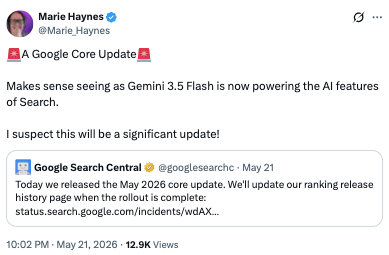
AI Overviews now appear across a growing number of searches, while Google’s Gemini-powered search experiences continue to evolve. As a result, traditional organic rankings and AI visibility are becoming increasingly interconnected. Websites that lose visibility in traditional search results are increasingly finding that their presence in AI-generated answers drops in parallel.
While Google has not disclosed exactly how these systems interact, the overlap suggests that the signals influencing organic rankings may also influence which sources appear in AI-powered search experiences.
5. User Experience is Part of the Equation Too
Slow pages, intrusive layouts, and frustrating mobile experiences can undermine visibility because they create a poor experience for users, something Google’s ranking systems have increasingly emphasized over time.
The AI search experience raises the bar further. Google is increasingly synthesizing answers directly in search results and rewarding the sources it considers most trustworthy, meaning a poor on-page experience can undermine credibility signals that took months to build.
6. Core Updates Are Part of a Larger Shift
Perhaps the biggest takeaway from the May 2026 core update is that it doesn’t appear to represent a dramatic change in direction.
Instead, it reinforces trends that have been building for several years: a stronger emphasis on E-E-A-T, greater focus on search intent, increasing importance of original content, and deeper integration of AI into the search experience.
We have also noted that core updates are becoming less about isolated ranking events and more about Google’s ongoing effort to refine how it evaluates and surfaces information.
The May 2026 update may have concluded on June 2, but the broader shifts it highlights are likely to continue shaping search long after the rollout ended.
Why Should Senior Living Organizations Pay Extra Attention?
Most industries can afford to treat a Google core update as background noise or something to monitor and revisit in a few weeks. Senior living doesn’t have that luxury. Here’s why this update hits differently for your sector.
1. You’re in Google’s Highest-scrutiny Category
Senior living sits squarely inside what Google classifies as “Your Money or Your Life (YMYL)” content — a designation reserved for industries where inaccurate or low-quality information could meaningfully impact someone’s health, finances, or wellbeing.
In plain terms, Google holds senior living pages to a stricter standard than most other industries. That means:
- Generic or templated care pages face greater scrutiny than equivalent pages in lower-stakes industries
- Content without verifiable authorship or institutional credibility is weighted more heavily against you
- Any gap between what your pages say and what families actually experience gets amplified in Google’s evaluation
Senior living sits squarely inside what Google classifies as “Your Money or Your Life (YMYL)” content — a designation reserved for industries where inaccurate or low-quality information could meaningfully impact someone’s health, finances, or wellbeing.
In plain terms, Google holds senior living pages to a stricter standard than most other industries. That means:
2. The Family Search Journey Starts Online
When families research senior living communities, websites with information and reviews are among the most helpful resources they rely on. In fact, they are nearly as influential as personal recommendations from family and friends.
Older adults initiated more than half of all senior living research in 2025, and adult children, spouses, and extended family remained closely involved throughout the process.That means before a family ever calls your community or schedules a tour, they’ve already formed an impression based on what Google surfaced. If your pages aren’t appearing or aren’t appearing credibly, that conversation never happens.
3. AI Overviews are Intercepting Your Most Valuable Searches
Some of the most common questions families ask during senior living research — “what is memory care,” “difference between assisted living and nursing home,” “how much does senior living cost” — are now being answered directly inside Google’s AI-generated answer boxes, before a family ever reaches your website.
What this means practically:
- Informational pages that once drove consistent traffic are now competing with Google’s own synthesized answers
- Only sources Google considers credible and authoritative get cited inside those AI Overviews
- Communities not already recognized as trusted sources are effectively invisible at the earliest stage of the family decision journey
4. Your Search Presence is Hyper-local and Hyper-vulnerable
Unlike national e-commerce brands that can absorb ranking volatility across thousands of pages, senior living operates in a narrow local radius. A single community typically competes for a small cluster of high-intent local searches. That concentration means:
- A ranking shift on even two or three key pages can have an immediate impact on inquiry volume
- Local pack visibility — the map results families see first — is subject to the same re-evaluation as organic rankings
- Communities that rely heavily on third-party aggregator sites like A Place for Mom or Caring.com face compounded risk if those platforms are also affected by the update
5. Corporate Copy is Losing to Community-specific Content
Aline’s 2026 Senior Living Benchmark Report, which analyzed data from more than 5,000 communities nationwide, found that effective engagement must speak to both the older adult and their trusted circle, aligning emotional readiness, practical concerns, and expectations across the entire decision group.
Google’s updated systems are reaching a similar conclusion algorithmically. Pages that feel corporate, templated, or interchangeable with any other community in the country are being outranked by pages that reflect genuine, localized expertise and real human perspective.
The update, in this sense, is simply catching up to what families already knew.
Which Websites Are Best Positioned Following the Update?
The May 2026 core update sent a clear message: Google wants websites to create content that genuinely helps users instead of content designed only to rank in search results.
Early data from across the industry points to a consistent pattern among the pages gaining visibility. They tend to share the following characteristics:
- Named, credible authorship: Pages with identifiable authors, clear professional credentials, and demonstrable expertise appear to be performing better than anonymous or generically attributed content.
- Depth over volume: Websites focusing deeply on one niche are building stronger authority signals. Google wants to understand what a website specializes in, which is why consistent topic coverage and interconnected content clusters matter more than ever.
- Original perspective: Content that demonstrates genuine knowledge through lived experience — rather than merely summarizing what others have already said — is what the update rewards.
- Strong local signals: Strong Google Business Profiles, consistent local citations, positive reviews, and locally relevant content continue to be important signals for local visibility.
- Pages built for people, not search engines: Pages that provide shallow explanations or generic summaries are struggling against comprehensive, experience-driven resources.
- An experience that doesn’t frustrate: Websites that load fast, work cleanly on mobile, and don’t get in the way of what a visitor came to find are holding up better than technically lagging sites.
The common thread across all of them is straightforward. The websites winning after this Google core update are the ones that would have earned a family’s trust anyway.
The Takeaway
Google’s May 2026 core update sharpened how Google recognizes quality, and senior living felt that shift more directly than most industries. We have also seen that communities that held their ground after this rollout shared something in common: an online presence built around genuine expertise, honest information, and content that speaks directly to families.
A lot still remains uncertain. Rankings are settling, AI Overviews continue to evolve, and another core update will arrive before the year is out. Not every question has a clean answer yet.
What we do know is that senior living organizations with a credible, people-first digital presence are better positioned for whatever comes next.
At Fountain Digital, we work with senior living organizations that want to be found for the right reasons. If you’re unsure where your community stands, we’re happy to take a look.
FAQs
What was the Google May 2026 core update?
The Google May 2026 core update was a broad algorithm update designed to improve the relevance and quality of search results. It began rolling out on May 21, 2026, and was completed on June 2, 2026, affecting rankings across a wide range of industries and website types.
What is E-E-A-T in SEO?
E-E-A-T stands for Experience, Expertise, Authoritativeness, and Trustworthiness. Google’s quality guidelines use these concepts to assess whether content comes from credible sources and provides reliable information to users.
How do Google core updates affect website rankings?
Google core updates can cause rankings to rise, fall, or remain unchanged as Google reassesses content across the web. A ranking change doesn’t necessarily indicate a penalty; it often reflects Google’s updated evaluation of which pages best satisfy user needs.
Why did my rankings drop after the Google May 2026 core update?
A ranking decline after a core update doesn’t necessarily mean your website was penalized. Google core updates are designed to reassess content across the web, which means rankings can change as Google re-evaluates which pages best satisfy user intent. In many cases, ranking shifts occur because competing content is perceived as more helpful, trustworthy, or relevant and not because something is wrong with your website.
How long does a Google core update take to roll out?
Most Google core updates take anywhere from a few days to several weeks to complete. The May 2026 core update began rolling out on May 21, 2026, and finished on June 2, 2026. During this period, it’s common to see ranking fluctuations as Google’s systems update and stabilize.
Does AI-generated content get affected by Google core updates?
Yes, but not simply because it was created using AI. Google has consistently stated that it evaluates content based on quality rather than how it was produced. Content that is accurate, helpful, original, and demonstrates expertise can perform well regardless of whether AI was involved. The bigger risk comes from publishing large volumes of low-value content that lacks human oversight, originality, or genuine expertise.